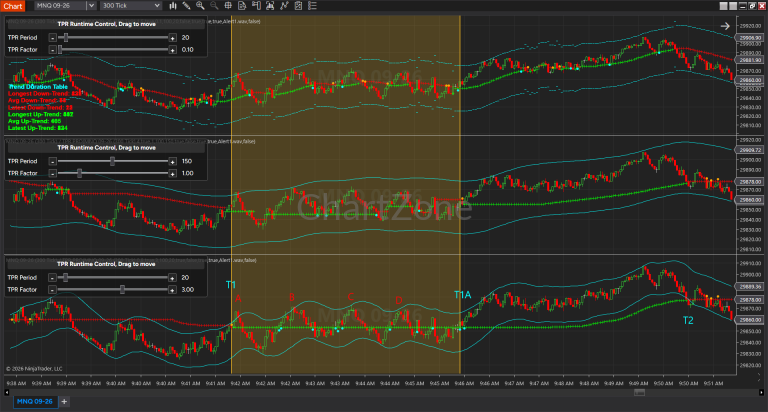
The TPR PullBack Channel is a core component of the TPR indicator, designed to systematically identify pullbacks within trending and ranging markets. It provides traders with a visual and quantitative framework to detect temporary counter-trend movements driven by short-term market imbalances.
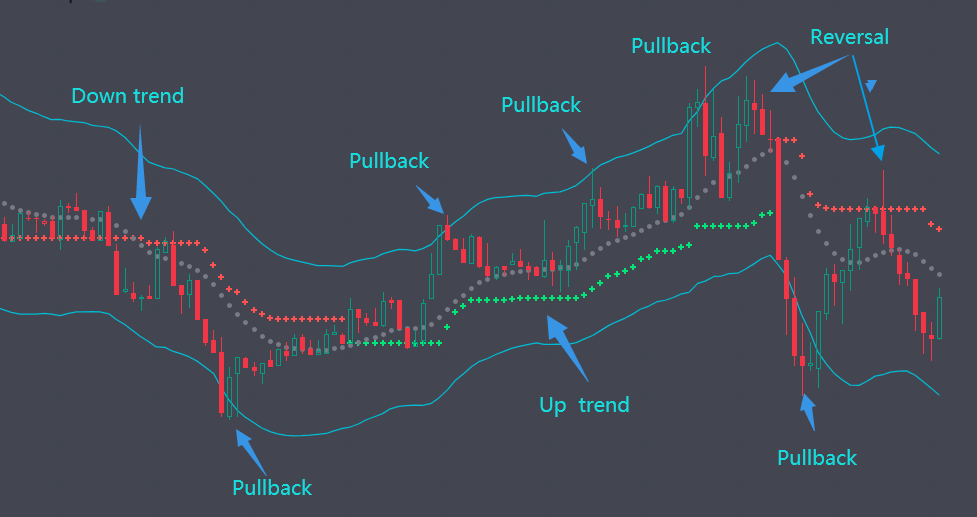
1. Understanding Pullbacks in Market Structure
A pullback is a temporary retracement against the prevailing trend. In most cases, pullbacks are caused by short-term overbought or oversold conditions, where price deviates too far from its equilibrium and reverts back before continuing in the original direction.
- In an uptrend, pullbacks are downward corrections
- In a downtrend, pullbacks are upward corrections
- In sideways markets, pullbacks occur within a range boundary
The ability to accurately detect these pullbacks is critical for:
- Trend continuation entries
- Risk-controlled positioning
- Avoiding late entries at extremes
2. What is the TPR PullBack Channel?
The TPR PullBack Channel is a dynamic price envelope built around the TPR trend structure. It acts as a volatility-adjusted boundary that defines where pullbacks are likely to occur.
Visually, the channel:
- Expands during high volatility
- Contracts during consolidation
- Tracks the underlying trend direction
When price interacts with the channel boundaries, it signals potential pullback zones.
3. The Key Parameter: PullBack Channel Factor
The behavior of the channel is controlled by a single critical input:
PullBack Channel Factor
This parameter determines the width and sensitivity of the channel.
Lower Values:
- Narrower channel
- More frequent pullback signals
- Higher sensitivity (more noise)
Higher Values:
- Wider channel
- Fewer but stronger pullback signals
- Lower sensitivity (filters weak moves)
Interpretation:
- A small factor is suitable for short-term trading (scalping, intraday)
- A larger factor is better for swing trading or higher timeframes
4. How to Identify Pullbacks Using the Channel
In an Uptrend:
- Price trends upward along the channel
- A pullback occurs when price retraces toward the lower band
- If structure holds, price resumes upward movement
Key Signal:
Pullback completion near the lower channel boundary
In a Downtrend:
- Price trends downward
- Pullback occurs when price retraces toward the upper band
- Trend continuation follows after rejection
Key Signal:
Pullback completion near the upper channel boundary
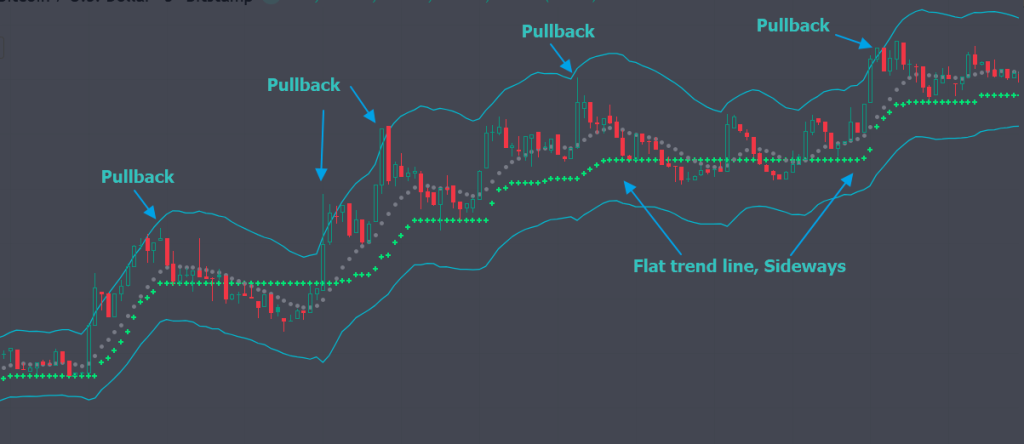
In Sideways Markets:
- The channel flattens
- Price oscillates between upper and lower bounds
- Pullbacks become range-based rather than trend-based
Key Signal:
Mean-reversion behavior within the channel
5. Combining PullBack Channel with TPR Trend Logic
The PullBack Channel should not be used in isolation. Its effectiveness increases when aligned with:
- TPR Trend Direction (green/red trendline)
- Market structure (higher highs / lower lows)
- Momentum shifts
High-Probability Setup:
- Confirmed trend (TPR direction)
- Price retraces into channel boundary
- Rejection or stabilization inside the channel
6. Practical Usage Guidelines
Entry Strategy:
- Enter after pullback confirmation, not during aggressive movement
- Use channel boundaries as reaction zones, not exact entry points
Risk Management:
- Place stops outside the channel
- Avoid trades when channel is flat and unclear
Optimization:
- Adjust PullBack Channel Factor based on:
- Asset volatility
- Timeframe
- Trading style
7. Key Advantages of the TPR PullBack Channel
- Filters noise from raw price action
- Adapts dynamically to volatility
- Provides clear visual structure
- Works across multiple markets (stocks, crypto, forex, futures)
The TPR PullBack Channel transforms the concept of pullbacks from subjective interpretation into a structured, rule-based framework. By adjusting the PullBack Channel Factor, traders can fine-tune sensitivity and align the indicator with their strategy.
Used correctly, it becomes a powerful tool for:
- Identifying high-probability continuation setups
- Avoiding overextended entries
- Improving overall trade timing